HMM-Based POS Tagger on the Brown Corpus
Objective
Write a program in Python to implement an HMM-based part-of-speech (POS) tagger for English.
Dataset: the Brown corpus (via NLTK), which contains words paired with their POS tags.
Mathematical model
An HMM tagger is a special case of Bayesian inference. We model \(P(Y \mid X)\), the probability of a tag sequence given a word sequence, using two kinds of probabilities:
- Emission probability: the likelihood of a word \(w_i\) given a tag \(t_i\), \(P(w_i \mid t_i)\).
- Transition probability: the likelihood of a tag given the previous tags, \(P(t_i \mid t_{i-1}, t_{i-2}, \dots, t_{i-k})\).
The best tag sequence is
\[ \hat{T} = \arg\max_T \prod_i P(w_i \mid t_i)\, P(t_i \mid t_{i-1}). \]
Training
Both probabilities are estimated from counts in the training set:
\[ P(t_i \mid t_{i-1}) = \frac{C(t_{i-1}, t_i)}{C(t_{i-1})}, \qquad P(w_i \mid t_i) = \frac{C(t_i, w_i)}{C(t_i)}. \]
Viterbi algorithm
\[ V_t(j) = \max_i V_{t-1}(i)\, a_{ij}\, b_j(o_t) \]
where \(V_{t-1}(i)\) is the previous Viterbi path probability, \(a_{ij}\) the transition probability, and \(b_j(o_t)\) the state observation (emission) likelihood.
The total number of possible tag sequences is \(T^W\) for \(T\) tags and \(W\) words, which is why dynamic programming is needed.
Assumptions
- The probability of a word depends only on its POS tag, and is independent of other words and tags.
- The probability of a tag depends only on the previous tag (bigram assumption).
Procedure
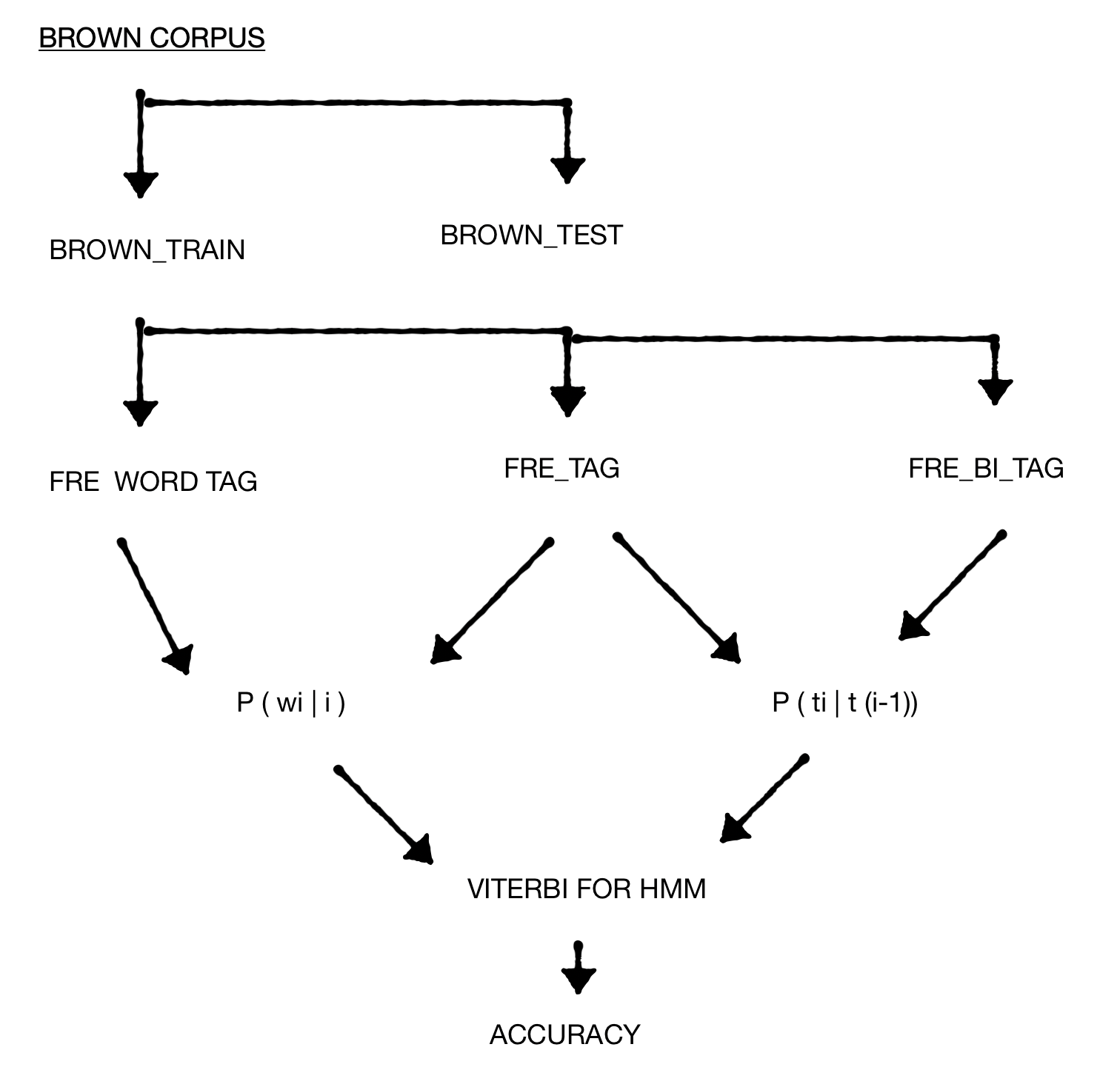
1. Split the corpus
Insert start <s> and end <\s> symbols in each sentence, then hold out the first 10 sentences for testing.
from nltk.corpus import brown

p = brown.tagged_sents()
brown_corpus = []
for i in p:
    i.insert(0, ('<s>', '<s>'))
    i.insert(len(i), ('<\\s>', '<\\s>'))
    brown_corpus.append(i)

brown_test = []
brown_train = []
sen = 0
for i in brown_corpus:
    sen += 1
    if sen <= 10:
        brown_test.append(i)
    else:
        brown_train.append(i)
2. Count patterns in the training set
We need three frequency tables:
fre_wordtag: frequency of each (word, tag) pairfre_tag: frequency of each tagfre_bi_tag: frequency of each tag given its previous tag
from collections import Counter

def fre(x):
    types = Counter(tuple(item) for item in x)
    freq = list(types.items())
    freq.sort(key=lambda f: f[1], reverse=True)
    return freq

# flatten training sentences into (word, tag) pairs
brown_words_tag = [j for i in brown_train for j in i]
fre_wordtag = fre(brown_words_tag)

# tag frequencies
brown_tag = [j[1] for i in brown_train for j in i]
fre_tag = list(Counter(brown_tag).items())
fre_tag.sort(key=lambda f: f[1], reverse=True)
3. Turn counts into probabilities
Emission probabilities \(P(w_i \mid t_i) = C(t_i, w_i) / C(t_i)\):
probWiti = []
for i in fre_wordtag:
    for j in fre_tag:
        if i[0][1] == j[0]:
            probWiti.append([i[0], i[1] / j[1]])
Transition probabilities \(P(t_i \mid t_{i-1}) = C(t_{i-1}, t_i) / C(t_{i-1})\), built from tag bigrams (skipping the <\s> → <s> sentence boundary):
bi_tag = []
x = len(brown_words_tag)
for j in range(x - 1):
    temp = [brown_words_tag[j][1], brown_words_tag[j + 1][1]]
    if temp != ['<\\s>', '<s>']:
        bi_tag.append(temp)

fre_bi_tag = fre(bi_tag)

probbitag = []
for i in fre_bi_tag:
    for j in fre_tag:
        if i[0][0] == j[0]:
            probbitag.append([i[0], i[1] / j[1]])
The set of all tags seen in training is simply:
pos_tag = [i[0] for i in fre_tag]Because a word’s probability depends on its tag and a tag’s probability depends on the previous tag, there is no UNK tag in the tagger itself; unknown words are handled separately below.
4. Viterbi decoding
With the probabilities in hand we build, for one test sentence, an emission lattice (only entries with non-zero emission probability, since a zero would zero out the whole path) and the set of transition probabilities among the tags that sentence can take.
sentance = brown_test[4]   # pick any of the first 10 test sentences
l = len(sentance)

lattic_emission = [[] for _ in range(l)]
sen_tag = []
for i in range(l):
    for j in probWiti:
        if sentance[i][0] == j[0][0]:
            lattic_emission[i].append(j)
            if j[0][1] not in sen_tag:
                sen_tag.append(j[0][1])
    if len(lattic_emission[i]) == 0:
        # unknown word: treat as 'NN' with probability 0.11
        lattic_emission[i].append([(sentance[i][0], 'NN'), 0.11])

# transition probabilities restricted to tags that appear in this sentence
tran_tag = [(i, j) for i in sen_tag for j in sen_tag]
tran_pro = [j for i in tran_tag for j in probbitag if i == j[0]]

# keep the highest-emission tag for each word, then chain transitions
max_emission = []
sequence = []
for i in lattic_emission:
    i.sort(key=lambda e: e[1], reverse=True)
    max_emission.append(i)

vi = []
for i in range(len(max_emission) - 1):
    vi.append((max_emission[i][0][0][1], max_emission[i + 1][0][0][1]))
    sequence.append(max_emission[i][0][0])
sequence.append(('<\\s>', '<\\s>'))

Vj = []
for i in range(len(vi)):
    for j in tran_pro:
        if vi[i] == j[0]:
            Vj.append(max_emission[i][0][1] * j[1])

def viterbi(Vj):
    result = 1
    for x in Vj:
        result *= x
    return result

print(sequence, '\n', viterbi(Vj))
5. Accuracy
count = 0
for i in range(len(sentance)):
    if sentance[i] == sequence[i]:
        count += 1
accuracy = count / len(sentance) * 100
print("accuracy of HMM tagger for given sentence is", accuracy)
Results
For sentence 4 of the test set:
[('<s>', '<s>'), ('The', 'AT-TL'), ('jury', 'NN-HL'), ('said', 'VBD'), ('it', 'PPS-HL'),
 ('did', 'DOD-NC'), ('find', 'VB'), ('that', 'WPS-NC'), ('many', 'AP-NC'), ('of', 'IN-TL'),
 ("Georgia's", 'NP$'), ('registration', 'NN'), ('and', 'CC-HL'), ('election', 'NN'),
 ('laws', 'NNS'), ('``', '``'), ('are', 'BER-HL'), ('outmoded', 'JJ'), ('or', 'CC-NC'),
 ('inadequate', 'JJ'), ('and', 'CC-HL'), ('often', 'RB'), ('ambiguous', 'JJ'), ("''", "''"),
 ('.', '.-HL'), ('<\s>', '<\s>')]
5.0121351597188597e-33
accuracy of HMM tagger for given sentence is
53.84615384615385
Viterbi returns the most probable tag sequence with a sentence probability of about \(5 \times 10^{-33}\). Compared against the gold tags, accuracy on this sentence is only 53.8%, lower than the unigram and bigram taggers from earlier assignments. Two reasons: the Brown tagset is very fine-grained (phrase-level suffixes such as -HL, -TL, -NC split what would otherwise be one tag), and the corpus is case sensitive, so the same word gets different tags depending on capitalisation. The HMM does, however, do a better job at identifying phrases.
Unknown words
Words not seen in training are tagged NN, since most training words are nouns. In earlier assignments tagging everything as NN gave about 11% accuracy, so unknown words are given an emission probability of 0.11 in the Viterbi product.
Comparison with other taggers
Exhaustive HMM decoding is expensive: with \(n\) tags and \(m\) words there are \(n^m\) tag sequences, which is why the Viterbi dynamic-programming algorithm is used to find the optimal one.
Like other stochastic taggers, an HMM tagger finds the most likely tag for a word or sequence of words. Unlike greedy taggers that tag one word at a time, the HMM tags a whole sentence at once, choosing the sequence that maximises
P(word | tag) * P(tag | previous n tags)The HMM outperforms the simpler taggers here, but it is not the most accurate option: an interpolated tagger can do better.
HMM and ambiguity
Because the HMM considers the whole sentence, it can surface ambiguity: an ambiguous sentence gets different probabilities for its different tag sequences, and the most plausible reading is the one with the highest probability.
Further work
- Extend the transition model to depend on three or more previous tags (trigram or higher-order HMM).
- Replace the count-based model with a neural sequence tagger.